

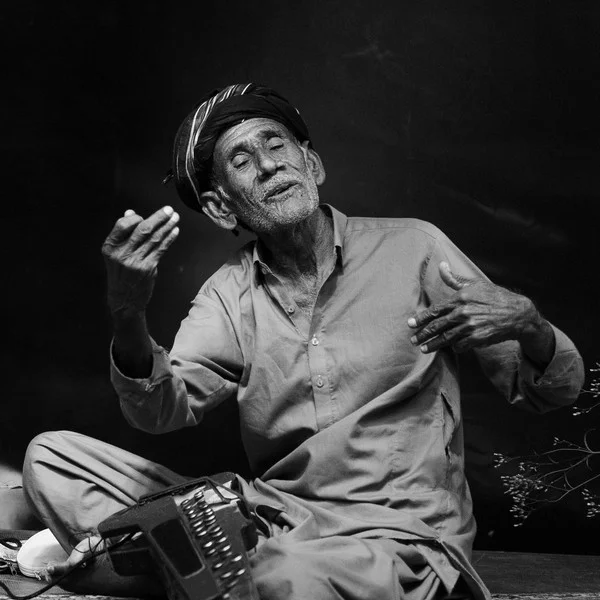
🎶 The Mystery of Balochistan’s Benjo Maestro: Ustad Noor Bakhsh
In the sun-baked hills of Balochistan, a land often associated with silence and resilience, a soulful sound echoes—melancholy yet electrifying. It’s not coming from a modern concert hall, but from a humble village, played by a man with weathered hands and a heart full of centuries-old tradition. That man is Ustad Noor Bakhsh: a mysterious banjo player, a folk magician, and an accidental internet legend.
🎵 A Musician Born of the Soil
Ustad Noor Bakhsh hails from Pasni, a coastal town along the Makran coast of Balochistan. He is no celebrity in the conventional sense—no social media, no formal music education, and no studio glamour. What he does have is a lifelong bond with the benjo, a Japanese instrument he has made uniquely his own.
Locally called the “benjo,” this instrument is a modified electric banjo, often seen in South Asian street music. But in Ustad Noor’s hands, it becomes something far more: a vessel for storytelling, lament, longing, and joy.
“میں نے سمندر کے کنارے بیٹھ کر بینجو بجانا سیکھا۔ ہر ساز میں قدرت کی آواز ہے۔”
“I learned to play sitting by the sea. Every string carries the voice of nature.”
— Ustad Noor Bakhsh
From Obscurity to Viral Fame
For years, Noor Bakhsh played at small community gatherings, weddings, and Sufi shrines. He was a living library of Baloch folk tunes, but virtually unknown outside his region—until a short video of him went viral in 2022.
Captured by the Lahooti Music Project, the video shows Ustad sitting in the desert, eyes closed, playing with raw passion. The haunting blend of Balochi scales and improvisational mastery left global listeners stunned.
Suddenly, a man with a solar-powered amplifier and a weather-beaten instrument became a global folk icon.
“There’s something trance-like in the way he plays—like a desert Sufi jamming with the wind.”
— Folk Music Blogger, Karachi

The Benjo as a Cultural Bridge
Noor Bakhsh’s music bridges generations and geographies. It’s neither polished nor commercial. Instead, it carries ancestral memory—the echo of camel caravans, Sufi saints, and the long-lost love stories sung in Balochi ballads.
Despite being rooted in Baloch tradition, his music resonates across languages and cultures. From Berlin to Bombay, people are listening—and feeling something ancient and universal.
A Living Legend, Still Humble
Even today, Ustad Noor Bakhsh lives simply. His fame hasn’t turned him into a mainstream icon, and he prefers it that way.
He continues to perform at local festivals, often barefoot, and never fails to thank his listeners with warmth and humility.
“میری دُھنیں مشہور ہو گئیں، مگر میں وہی نور بخش ہوں۔”
“My melodies became famous, but I remain the same Noor Bakhsh.”
— Ustad Noor Bakhsh
A Desert Sufi with a Benjo
Ustad Noor Bakhsh’s story is not just about music—it’s about cultural survival, the power of simplicity, and the unexpected ways in which the world rediscovers its forgotten heroes.
As his notes float across digital platforms and desert winds, we are reminded that some of the most powerful art emerges from silence, solitude, and sincerity